Who Owns the Fence? Property Lines and Shared Repairs
How to find out whether a boundary fence is yours, theirs, or shared, who pays for repairs, and how to handle a fence built on the wrong side of the line.
Who Owns the Fence? Property Lines and Shared Repairs
The fence between you and your neighbor blows down, or starts leaning, or someone wants to replace it. Then comes the question nobody has ever actually settled: whose fence is it?
It is one of the most common sources of friction between neighbors, and one of the easiest to make worse by guessing. Here is how to find out for certain and what to do with the answer.
Start With the Documents, in Order
Work through these in sequence. Each is more definitive than the last.
1. Your deed. It contains the legal description of your property boundaries. It will not usually mention the fence, but it establishes where your land ends, which is the question underneath the question.
2. The plat map. Filed with your county, this shows your lot's dimensions and its position relative to neighboring lots. Often available online through the county recorder or assessor.
3. Your closing documents. Any survey performed at purchase will be in there, and sometimes a recorded fence or boundary agreement from a previous owner. Recorded agreements bind subsequent owners, so a deal struck twenty years ago may still govern.
4. A professional survey. The only definitive answer. A licensed surveyor locates the actual boundary and marks it. It costs money and it ends the argument, which on a disputed boundary is usually worth it. If you are about to spend thousands on a fence, spending a fraction of that to know where it legally goes is straightforward math.
Do not rely on the existing fence to tell you where the line is. Fences get built in the wrong place routinely, sometimes by accident and sometimes for convenience, and a long-standing fence in the wrong position can create legal complications of its own.
Most Boundary Fences Are Shared
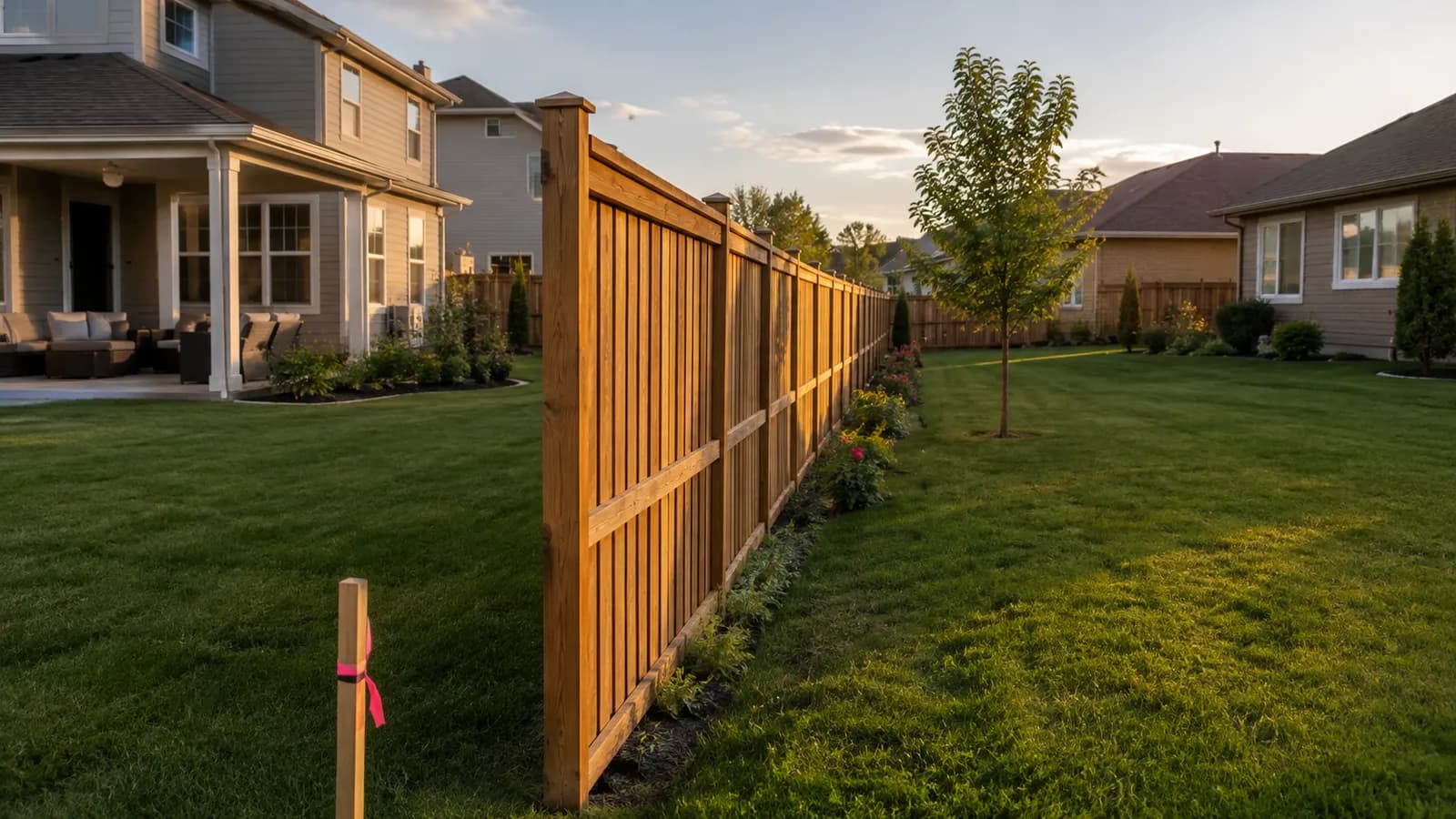
In the majority of cases a fence sits wholly or partly on the property line itself, which generally means ownership and responsibility are shared between both property owners.
That has a practical consequence people find surprising: where a fence is genuinely a shared boundary fence, both owners are typically obligated to contribute to reasonable repair and maintenance, whether or not they wanted the work done.
Many states have specific statutes governing shared boundary fences, sometimes called good neighbor fence laws, which set out how costs are apportioned and what notice must be given before work starts. These vary substantially, and some require written notice to your neighbor with specified content and timing before you can claim a contribution. Check your own state's rules before assuming either that your neighbor must pay or that they need not.
Where a fence sits entirely inside one owner's property, it generally belongs to that owner alone, along with the full cost of maintaining it.
Working Out Who Has Been Responsible
Where documents are ambiguous, history helps. Assemble what you can:
- Who built it, and who paid.
- Who has repaired it since, and when.
- Any written agreement between previous owners.
- Photographs over time, which often show more than anyone remembers.
None of this overrides a survey, and all of it matters if the question ever gets formal. It also matters for the far more common outcome, which is an informal conversation where both parties want to be reasonable and neither can remember what was agreed.
If the Fence Is on the Wrong Side of the Line
A survey sometimes reveals that a fence, yours or theirs, encroaches. This is where things get delicate, and where acting hastily causes the most damage.
Do not tear anything down. Removing a neighbor's structure yourself, even one standing on your land, exposes you to liability and converts a solvable problem into a lawsuit.
The sensible order:
- Talk to your neighbor first, with the survey in hand. A large proportion of encroachments are genuine accidents by a previous owner and get resolved in one conversation.
- Consider whether it actually matters. If the encroachment is a few inches of side yard and nobody is losing anything, a written agreement acknowledging the true boundary while allowing the fence to remain may serve everyone better than a fight.
- Put whatever you agree in writing, and consider recording it so it binds future owners rather than resurfacing at resale.
- If it cannot be resolved, legal remedies exist, including negotiating removal, seeking an injunction requiring removal, a quiet title action to confirm ownership of the disputed strip, or damages where the encroachment has reduced your property's value or interfered with your use of the land.
There is also a reason not to leave an encroachment indefinitely unaddressed. In many states, long, open, continuous use of another person's land can eventually ripen into a legal claim to it. The rules and timescales vary, and the possibility is a good argument for documenting the true boundary in writing even when you are content to let the fence stay.
Before You Build or Replace
If you are the one doing the work, front-load the problems:
- Know where the line is, by survey if there is any doubt.
- Tell your neighbor before you start. Some states legally require notice on a shared boundary fence, and it is worth doing regardless.
- Check whether you need a permit. Height limits and setbacks are commonly zoning matters, and corner lots and front yards frequently face extra restrictions.
- Check your HOA rules on materials, height, color, and the finished side orientation.
- Agree who pays what, in writing, before anyone orders materials. A short written note settles more disputes than any amount of goodwill.
- Consider building slightly inside your own line if you want unambiguous sole ownership and control. You give up a few inches and remove the entire shared-responsibility question.
Frequently Asked Questions
Which side of the fence should face my neighbor?
The common convention is that the finished side, with rails and posts concealed, faces outward toward the neighbor and the street, leaving the structural side facing in. It is often described as a courtesy, but it is not always merely that: some municipalities and a great many HOAs make it an actual requirement, and building it the other way around can mean being told to turn it. Where the fence is a genuinely shared boundary fence paid for by both parties, the orientation is something to agree between you rather than assume. Check your local code and your HOA's architectural standards before ordering, because reversing a completed fence is expensive and entirely avoidable.
Can I make my neighbor pay half?
Sometimes, and it depends heavily on your state and on following the right process. Where a fence genuinely sits on the boundary and serves both properties, many states have statutes requiring both owners to share reasonable costs of construction and maintenance. Those statutes usually come with conditions: advance written notice describing the work and the estimated cost, a reasonable opportunity for the neighbor to respond or to obtain their own quotes, and sometimes a requirement that the work be necessary rather than merely desired. Skip the notice and you may lose the right to claim a contribution even where the underlying obligation exists. If you are hoping to split the cost, research the requirement and follow it precisely before work begins.
What if my neighbor refuses to maintain a shared fence?
Start with a written request describing the specific problem and what needs doing, keeping a copy. It creates a record and sometimes resolves the matter on its own. If the fence is genuinely shared and your state has a boundary fence statute, that statute usually provides a mechanism, often allowing you to do the work and recover a share of the cost, provided you gave proper notice first. Small claims court is well suited to the amounts involved and does not require a lawyer. Before escalating, consider whether the relationship is worth more than the money, since you will still live next to this person afterward, and a mediated compromise often costs less in every sense.
Get Fence Quotes Once You Know Where the Line Is
Settle the boundary first, then price the work.
On Win My Work you can describe your fence project once, with photos and property mapping to show contractors exactly what you need, and receive competing quotes from verified, licensed and insured local contractors. Our guide to why quotes differ so much explains what to compare once they arrive.
Ready to Start Your Project?
Get free quotes from verified, licensed and insured local contractors on Win My Work - safe, with no obligation.